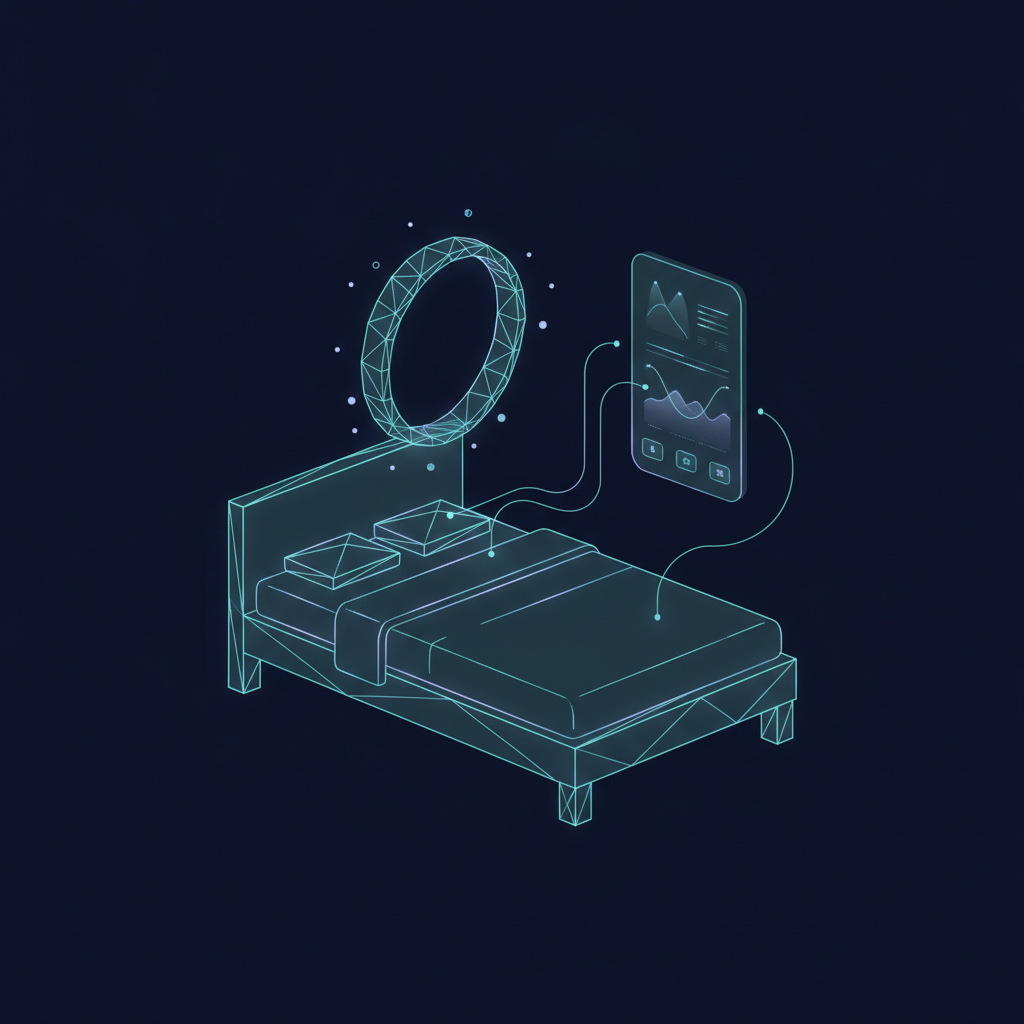
Smart sleep technology in 2026 includes AI-enabled beds, biometric rings, and adaptive apps that can analyze your sleep and actively improve it. This guide covers what the science supports, what each tool does, and which options are worth your money.
The global sleep technology market is expanding rapidly, driven by growing awareness around sleep’s role in long-term health. BedTimes Magazine reported in early 2026 that AI-enabled smart beds and connected bedroom devices are reshaping the category, with manufacturers integrating machine learning to move from passive monitoring to active sleep optimization. For consumers, this means more capability, but also more complexity to sort through.
Not all sleep tech is created equal. A $30 app and a $2,000 AI mattress both claim to improve your sleep, but the underlying mechanisms and the evidence behind them differ considerably. Understanding the landscape helps you spend wisely and use these tools to their full potential.
What the Research Actually Says About Sleep Tech
Sleep science has come a long way from polysomnography (PSG), the hospital-based gold standard that measures brain waves, oxygen levels, heart rate, and muscle activity. Consumer devices can’t replicate PSG, but some have closed the gap meaningfully.
Research published in peer-reviewed journals suggests that modern wearable trackers, particularly those using photoplethysmography (PPG) sensors to measure heart rate variability, can estimate sleep stages with moderate accuracy. A 2025 review found that leading consumer devices achieved roughly 80% accuracy for identifying sleep vs. wakefulness, and around 65-70% for distinguishing specific stages like REM and deep sleep. That’s useful directional data, even if it shouldn’t be read as clinical precision.
AI-enabled mattresses introduce a different category of intervention. Rather than measuring sleep passively, they actively respond to it. Some models adjust firmness zones based on detected sleep position, while others modulate mattress temperature in real time. Temperature regulation is one of the more evidence-backed levers for sleep quality: research suggests that core body temperature naturally drops at sleep onset, and sleeping in a cooler environment (typically 65-68°F) may support longer periods of deep sleep.
App-based sleep tools occupy a wide spectrum. Relaxation and CBT-i (cognitive behavioral therapy for insomnia) apps have the most clinical backing, with multiple randomized controlled trials suggesting CBT-i may be effective as a first-line approach for chronic insomnia. Ambient sound and sleep-staging apps with no biometric input have weaker evidence, though some users report subjective improvements in how rested they feel.
How to Think About Sleep Technology: A Framework
Rather than asking “which device is best,” it’s more useful to ask what problem you’re trying to solve. Sleep technology generally falls into three categories:
Measurement tools: Devices that track your sleep and give you data. Wearables like rings and smartwatches are the primary examples. They won’t change your sleep on their own, but they can reveal patterns you’d otherwise miss: chronic sleep debt, poor sleep efficiency, or a correlation between evening habits and next-day readiness scores.
Environmental optimization tools: Smart mattresses, temperature-regulating pads, smart lighting, and white noise machines fall here. These don’t require active behavior change; they work in the background to create conditions associated with better sleep. The tradeoff is higher upfront cost.
Behavioral intervention tools: Apps that guide relaxation, deliver CBT-i programs, or prompt journaling and habit logging. These require consistent use but carry some of the strongest evidence for people dealing with sleep difficulties.
The most effective approach for most people combines elements from at least two categories: a tracker to surface data, paired with either an environmental tool or a behavioral app to act on it. Data without action tends to produce anxiety rather than better sleep.
Common Misconceptions About Smart Sleep Devices
“More data means better sleep.” Not automatically. Orthosomnia (a term coined by sleep researchers to describe excessive preoccupation with sleep tracker data) is a documented phenomenon. Some people become so focused on hitting “perfect” sleep scores that the monitoring itself disrupts their sleep. If checking your sleep stats first thing in the morning changes your mood, consider a periodic rather than daily review.
“AI beds can fix insomnia.” Environmental optimization can support healthy sleep hygiene, but it won’t address underlying causes of sleep disorders: anxiety, irregular schedules, sleep apnea, or medication effects. If you suspect a clinical sleep disorder, a smart mattress is not a substitute for evaluation by a healthcare provider.
“All sleep trackers measure the same things.” They don’t. Wrist-based optical sensors measure slightly different signals than finger-worn devices, which behave differently again from under-mattress sensors. Accuracy varies by metric: heart rate tends to be reliable across devices, while REM sleep detection is considerably harder. Research suggests that ring-form-factor devices may capture blood flow signals more accurately than wrist-worn watches due to the finger’s vascular anatomy.
“Subscription-free means feature-complete.” Many trackers now gate their most useful features — trend analysis, readiness scores, AI coaching — behind monthly subscriptions. Factor this into total cost of ownership before purchasing.
When Smart Sleep Technology Is (and Isn’t) Right for You
Sleep technology tends to deliver the most value for people who:
- Are curious about their sleep patterns but have no clinical sleep disorder
- Have lifestyle factors (shift work, travel, variable schedules) that make sleep consistency difficult to assess without data
- Want to understand how behaviors like alcohol, exercise timing, or stress affect their sleep quality
- Are looking to optimize recovery for athletic performance or demanding work schedules
It may be less appropriate, or worth pausing on, if you:
- Already struggle with health anxiety or a tendency to fixate on biometric data
- Have been diagnosed with insomnia, sleep apnea, or another sleep disorder (see a specialist first)
- Find that tracking your sleep makes you feel worse about it rather than empowered
- Are not yet addressing foundational sleep hygiene (consistent schedule, dark room, limiting screens before bed)
No device can fully replace a regular schedule, a cool room, and a consistent wind-down routine. Technology works best as a complement to good habits, not a shortcut around them.
Tools and Products Worth Considering in 2026
The sleep tech market spans a wide price range, and the right choice depends on your goals, budget, and how much you want to interact with data.
Wearable Sleep Trackers
For wearable sleep tracking, the three platforms that dominate in 2026 are Oura Ring, WHOOP, and Garmin. Each takes a meaningfully different approach. Oura Ring (hardware $350-$500, subscription $6/month) prioritizes ring-form biometrics and provides detailed readiness scores. WHOOP (subscription-only, $30/month) focuses on athletic recovery and tracks HRV trends over time. Garmin devices ($250-$900) integrate sleep data into a broader fitness ecosystem without a mandatory subscription.
Our detailed breakdown of how these platforms compare across accuracy, features, and use cases is in our Oura Ring vs WHOOP vs Garmin comparison. For a wider look at the category (including budget-friendly options), our best sleep trackers of 2026 guide covers over a dozen devices with head-to-head analysis.
AI Smart Mattresses
Smart mattresses represent the highest-investment category. Eight Sleep, Sleep Number, and Casper each integrate different forms of sleep technology, from active temperature regulation to biometric monitoring built into the sleep surface itself. Prices range from $1,500-$4,000+ depending on size and model. These are long-term investments that work best for people who sleep hot, share a bed and have different comfort preferences, or want environmental optimization without wearing a device to bed.
We’ve compared the leading platforms side by side in our Eight Sleep vs Sleep Number vs Casper smart mattress comparison, including which performs better for temperature-sensitive sleepers and couples with different preferences.
Sleep Apps
For app-based support, CBT-i apps with structured programs (Sleepio, CBTI Coach) have the most research backing for improving insomnia symptoms. Meditation and wind-down apps like Headspace and Calm offer strong relaxation content with varying levels of sleep-specific programming. See our Headspace vs Calm vs Insight Timer comparison for a feature breakdown across the major platforms.
Frequently Asked Questions
Are consumer sleep trackers accurate enough to be useful?
Research suggests modern consumer devices are reasonably accurate for overall sleep duration and basic sleep vs. wake detection, though sleep stage classification (particularly REM vs. light sleep) carries more variability. For most people, the trend data and behavioral correlations are more actionable than any single night’s staging breakdown.
Do AI mattresses actually improve sleep quality?
Some research supports the role of temperature regulation in sleep quality, which is one of the primary mechanisms used by AI mattresses. Evidence is more limited for other claimed features. Users tend to report the strongest satisfaction with temperature control benefits, particularly for people who sleep hot or in households where partners prefer different mattress feels.
Can sleep apps replace seeing a doctor for insomnia?
CBT-i based apps are associated with meaningful improvements in chronic insomnia symptoms and are considered a legitimate first-line intervention by many sleep clinicians. However, if you have or suspect a sleep disorder like sleep apnea, restless legs syndrome, or narcolepsy, professional evaluation is important. Apps are a complement to medical care, not a substitute for it, when a clinical issue is present.
Is it worth paying for a subscription tracker vs. a one-time purchase device?
It depends on the features behind the paywall. If the core metrics you want (nightly sleep duration, heart rate, HRV) are available without a subscription, a one-time purchase may be sufficient. Subscription-gated features like AI coaching, long-term trend analysis, and readiness algorithms can add meaningful value for users who engage with the data regularly. Evaluate what you’ll actually use before committing to ongoing costs.
How long should I use a sleep tracker before seeing useful patterns?
Most sleep researchers suggest at least two to four weeks of consistent tracking before drawing conclusions about personal baselines. Night-to-night variation is normal; weekly and monthly averages are more informative than any single data point. It also takes time to understand how your specific behaviors correlate with your tracker’s metrics.
What’s the one sleep habit that still matters more than any technology?
Consistency. A regular sleep and wake time, even on weekends, is one of the most reliably supported behaviors in sleep research. No device or AI system has been shown to substitute for a stable circadian rhythm anchored by consistent timing. Technology works best when it’s built on that foundation.
More from the CWH Sleep Series
- Magnesium Glycinate for Sleep
- How to Choose a Mattress for Your Sleep Position
- Air Quality and Sleep: Why Your Air Purifier Matters
- Screen Time Is Killing Your Sleep
- How Poor Sleep Speeds Up Biological Aging
- Mouth Taping for Sleep: Does the Science Support It?
- Sleep and Cognitive Decline: The Brain Circuit
- Sleep Tourism 2026
Bottom Line
Smart sleep technology in 2026 offers more capability than ever, from AI mattresses that modulate temperature throughout the night to ring-form biometrics that track HRV with increasing precision. Research suggests these tools can surface genuine insights about sleep patterns and, in the case of temperature regulation and CBT-i apps, may actively support better rest. The key is matching the right tool to your specific situation: understanding whether you need data, environmental optimization, or behavioral support, and keeping realistic expectations about what technology can and cannot do.
Start with a clear question you want answered about your sleep. Let that question guide your investment, not the marketing. And remember that the most sophisticated sleep tracker in the world works best when it’s sleeping in a dark, cool room alongside someone who goes to bed at the same time every night.