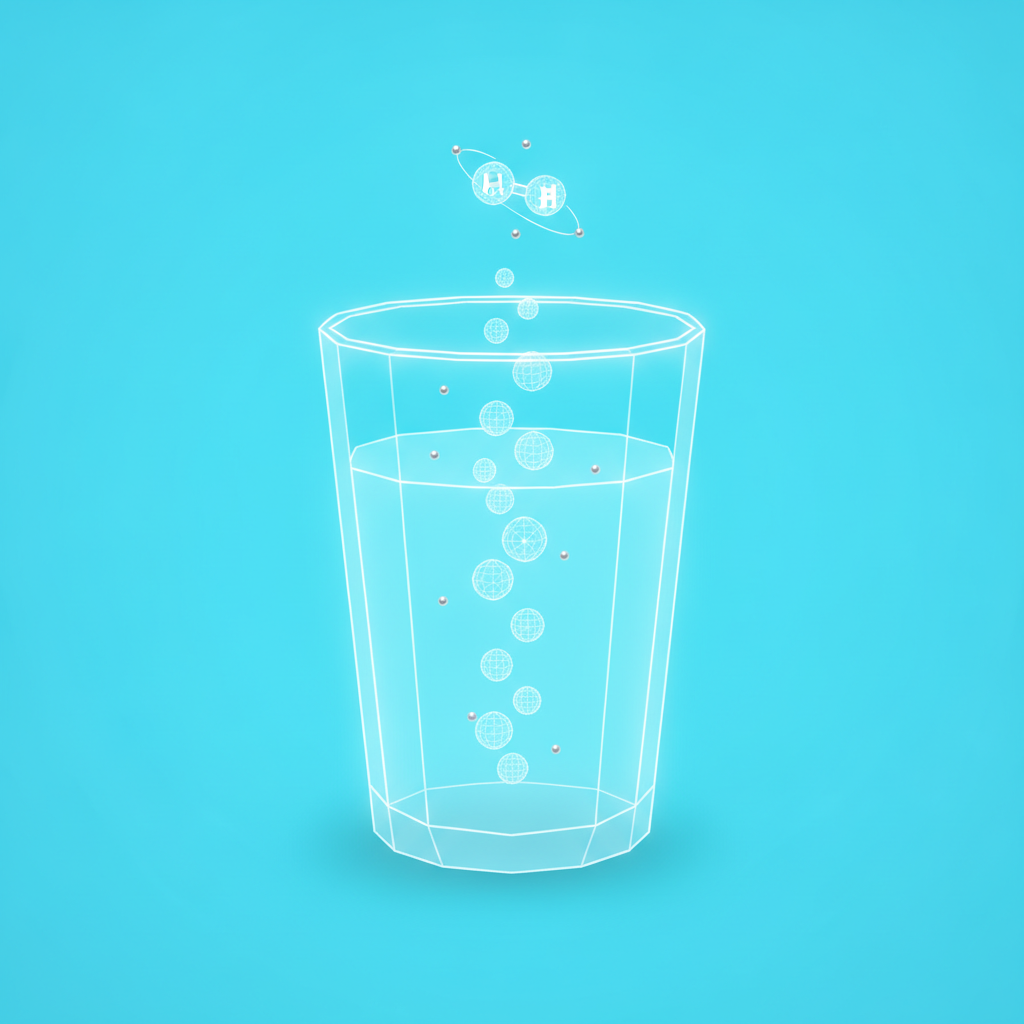
Hydrogen water is plain water infused with extra molecular hydrogen gas (H2). The short answer on whether it works: the evidence is promising but early, with most human trials small in scale and short in duration. As of 2026, no major regulatory body has approved hydrogen water to treat or prevent any medical condition.
What sets hydrogen water apart from regular water is the dissolved H2 gas, which researchers believe may act as a selective antioxidant, targeting the most cytotoxic free radicals while leaving beneficial reactive oxygen species intact. That selectivity is what has drawn scientific attention, along with substantial investor money.
Whether that mechanism translates into meaningful everyday benefits is where the scientific community remains divided. Here is what the research shows, what skeptics argue, and how to think about hydrogen water if you are considering it.
What the Research Actually Says
The bulk of hydrogen water research comes out of Japan, where the compound has been studied since a 2007 landmark paper by Ohsawa et al. in Nature Medicine showed H2 reduced oxidative stress markers in a rodent model of ischemia.
Oxidative stress and antioxidant markers
The most consistent signal across human trials is a reduction in blood and urinary markers of oxidative stress. A 2020 randomized controlled trial in Medical Gas Research found that subjects drinking hydrogen-rich water for eight weeks showed statistically significant reductions in malondialdehyde (MDA), a standard oxidative damage marker, versus placebo, though effect sizes were modest.
Athletic performance and recovery
Several small trials have examined hydrogen water in exercise contexts. A 2024 pilot study in Frontiers in Physiology found that trained cyclists using hydrogen water before and after high-intensity intervals reported lower perceived muscle soreness at 24 hours versus placebo, with no significant difference in performance metrics; the small sample (n=18) limited interpretive power.
A 2023 meta-analysis in the Journal of the International Society of Sports Nutrition pooled eight randomized trials and concluded that hydrogen water “may modestly attenuate exercise-induced oxidative stress,” but found insufficient evidence to recommend it as an ergogenic aid. Mean effect on VO2max was non-significant.
Metabolic and cardiometabolic markers
Some trials in metabolic syndrome populations have shown improvements in LDL particle size and HDL cholesterol. A frequently cited 2010 pilot trial (Nakao et al.) found favorable lipid changes after 10 weeks of hydrogen-rich water, but it had just 20 participants and no long-term follow-up, and larger replication trials have not consistently reproduced the magnitude of those results.
Neurological and cognitive outcomes
Animal studies show neuroprotective effects of dissolved hydrogen in models of Parkinson’s disease, traumatic brain injury, and cognitive aging, but human translation has been limited: a 2022 double-blind trial in older adults with mild cognitive complaints found no significant improvement on standard cognitive scores after 12 weeks of hydrogen water versus placebo.
What the skeptics say
Critics point to three consistent problems: small samples, short durations, and publication bias toward positive findings. A 2023 review in Critical Reviews in Food Science and Nutrition noted that most favorable trials come from groups with financial ties to hydrogen water manufacturers, and that independent replication has been mixed; the reviewers called for multi-center, independently funded trials before any clinical recommendations could be made.
How to Think About Hydrogen Water
If the evidence intrigues you, here is a framework for deciding whether hydrogen water fits your wellness routine.
Understand the delivery format differences
Hydrogen gas dissipates rapidly once water is exposed to air, so format matters. Aluminum pouches and capped electrolysis devices (home generators) preserve dissolved H2 better than open bottles or tablets dissolved in advance. Look for quantified parts-per-million (ppm) concentrations rather than vague claims; effective concentrations in trials typically range from 0.5 to 1.6 ppm.
Contextualize it within your existing supplement stack
Hydrogen water is not a replacement for diet quality, sleep, or exercise; its antioxidant mechanism addresses just one of many pathways in cellular aging and inflammation. If your foundational habits are inconsistent, it is unlikely to produce noticeable effects; if they are already strong, it is more likely a modest add-on than a centerpiece. For more on how supplement timing and stacking affect efficacy, see our guide to supplement timing mistakes.
Match expectations to the evidence tier
Hydrogen water sits in what researchers sometimes call a “promising preliminary stage,” the same tier occupied by many nootropic compounds awaiting large trials. People under high biological stress (elite athletes, those with metabolic dysfunction, heavy environmental exposures) may see more signal than sedentary, otherwise healthy individuals.
Consider cost versus opportunity cost
Hydrogen water products span a wide price range, from a few dollars per single serving to several hundred dollars for a home generator (specific ranges below). Before committing, consider whether that budget could close larger gaps elsewhere in your routine, such as sleep quality, micronutrient coverage, or protein intake. If those bases are covered, the cost-to-benefit ratio of hydrogen water becomes more defensible.
Common Misconceptions About Hydrogen Water
Misconception 1: “It’s the same as alkaline water”
These are distinct product categories with different mechanisms: alkaline water adjusts pH, while hydrogen water adds dissolved H2 gas. Some products market both properties together, but the biological rationale differs entirely, and the antioxidant mechanism attributed to hydrogen water does not depend on pH.
Misconception 2: “More hydrogen concentration is always better”
Research does not support a linear dose-response relationship above the concentrations used in trials (roughly 0.5 to 1.6 ppm). Products claiming much higher concentrations have not been tested at those levels in controlled human trials, and it is unclear whether excess dissolved H2 adds benefit or simply off-gasses before consumption.
Misconception 3: “Clinical-grade evidence already exists”
Some marketing cites the volume of published studies as evidence of clinical validation. As of 2026, no major health authority, including the FDA, EFSA, or NHS, has classified hydrogen water as a medically validated intervention, and published studies, even positive ones, are not equivalent to regulatory approval or clinical guidelines.
Misconception 4: “It detoxifies the body”
Hydrogen water does not “detoxify” in any clinically recognized sense. Its proposed mechanism is antioxidant, targeting specific reactive oxygen species; the liver and kidneys handle metabolic waste clearance regardless of hydrogen water intake. Claims about “flushing toxins” reflect marketing language, not established physiology.
Misconception 5: “Natural spring water already contains hydrogen”
All water contains hydrogen atoms as part of H2O, but dissolved molecular hydrogen gas (H2) at meaningful concentrations is a separate matter. Most tap and spring water contains negligible dissolved H2; hydrogen water products specifically add H2 gas to reach the concentrations used in research.
Cautions and Who Should Avoid Hydrogen Water
Cautions / Who should avoid: Hydrogen water has a low acute risk profile in healthy adults at the concentrations used in studies. However, individuals on immunosuppressive therapy should consult a physician first, since any compound modulating oxidative signaling may interact with treatment protocols. Pregnant or breastfeeding individuals should avoid it until safety data in those populations exists, and people with diagnosed kidney disease should confirm fluid intake adjustments with their care team. Hydrogen water is not a substitute for prescribed medications or treatments.
When Hydrogen Water Is and Is Not Right for You
Scenarios where it may be worth exploring
- You’re a competitive or frequent endurance athlete seeking marginal recovery support and have already optimized foundational habits.
- You have documented high oxidative stress markers (confirmed via bloodwork) and want a low-risk adjunct intervention under medical guidance.
- You’re interested in longevity research and comfortable trying interventions at the “promising but unconfirmed” evidence tier, with realistic expectations.
Scenarios where it is likely not the right priority
- You’re looking for a primary wellness intervention and haven’t yet addressed sleep quality, diet diversity, or consistent exercise.
- You have a specific diagnosed condition and are considering hydrogen water as a treatment; work with a licensed healthcare provider instead.
- Your wellness budget is limited. The cost-to-evidence ratio favors established supplements with stronger human evidence bases first.
For a broader look at evidence-graded supplementation across wellness categories, our review of best nootropic supplements walks through a similar hierarchy of evidence for cognitive-focused compounds.
Products and Tools That May Help
The main hydrogen water product categories are bottled water (single-serve aluminum pouches or cans), electrolysis devices (home generators that infuse H2 into tap water), and hydrogen tablets dissolved in water immediately before drinking.
Electrolysis devices that generate hydrogen on demand tend to preserve concentration better than pre-bottled products, which lose dissolved gas over time even when sealed. Look for independent concentration verification (ppm certified by third-party testing), not just manufacturer claims.
Hydrogen water is one of several wellness hydration products that have grown alongside the broader supplement market. If you’re building out a supplement stack, our roundup of best greens powders covers foundational nutrition products that complement antioxidant-focused supplementation, and our guide to men’s health supplements covers energy and recovery essentials with stronger evidentiary backing. Reading labels critically matters for any supplementation decision; our guide on how to read supplement labels explains what third-party certifications actually mean.
Typical pricing ranges: single-serve hydrogen water pouches run $3 to $5 per serving; home electrolysis generators range from $80 to $400 depending on output and build quality; hydrogen tablet packs typically run $20 to $50 for a 30-day supply.
Frequently Asked Questions
Is hydrogen water safe to drink daily?
At concentrations used in current research (0.5 to 1.6 ppm), hydrogen water appears well tolerated in healthy adults based on available short-term data, with no serious adverse events reported in published studies. Long-term safety data beyond 12 months is limited, so people with existing health conditions should consult a physician before making it a daily habit.
How is hydrogen water different from regular filtered water?
The difference is the dissolved molecular hydrogen gas (H2). Standard filtered water removes contaminants but does not add H2, and the proposed benefit of hydrogen water is specifically attributable to that dissolved gas, not the water itself. Our guide to best water filters covers filtration technology separately from hydrogen enrichment.
Can you make hydrogen water at home?
Yes. Home electrolysis devices generate hydrogen by running an electrical current through water to produce dissolved H2, and quality varies considerably by device. Look for devices with documented output concentrations and food-grade materials in the water contact surfaces.
Does hydrogen water help with inflammation?
Some studies report reductions in inflammatory markers (CRP, interleukin-6) alongside oxidative stress markers, but results are not consistent across trials. Inflammation involves many pathways, and hydrogen water’s proposed mechanism addresses only one subset of oxidative-inflammatory signaling, so it should not be considered an anti-inflammatory treatment in the clinical sense.
How quickly might you notice an effect?
Trials reporting positive outcomes typically ran 8 to 12 weeks of daily use; expecting acute effects after a single serving is not supported by the research. Quick subjective improvements are possible, but placebo response is a real, well-documented factor in wellness trials and cannot be ruled out without controlled conditions.
Is hydrogen water the same as “oxygenated water”?
No. Oxygenated water is infused with oxygen (O2) and marketed primarily for athletic performance, while hydrogen water is infused with molecular hydrogen (H2). The mechanisms and research bases differ, and the two should not be confused despite superficial similarity in marketing language.
Bottom Line
Hydrogen water occupies a genuine scientific grey zone in 2026: not pseudoscience, but not proven medicine either. The antioxidant mechanism is biologically plausible, a portion of the human trial data is positive, and the acute safety profile at studied concentrations appears favorable. What is missing is the kind of large-scale, independently replicated, long-duration clinical evidence that would justify confident health recommendations.
For most people, hydrogen water is a reasonable area of curiosity but should not displace foundational wellness priorities. If you have strong habits in sleep, nutrition, and physical activity and want to explore supplements at the “promising but unconfirmed” tier, it fits that profile. Go in with realistic expectations, choose products with documented H2 concentrations, and check back on the evidence as larger trials report out over the next few years.